
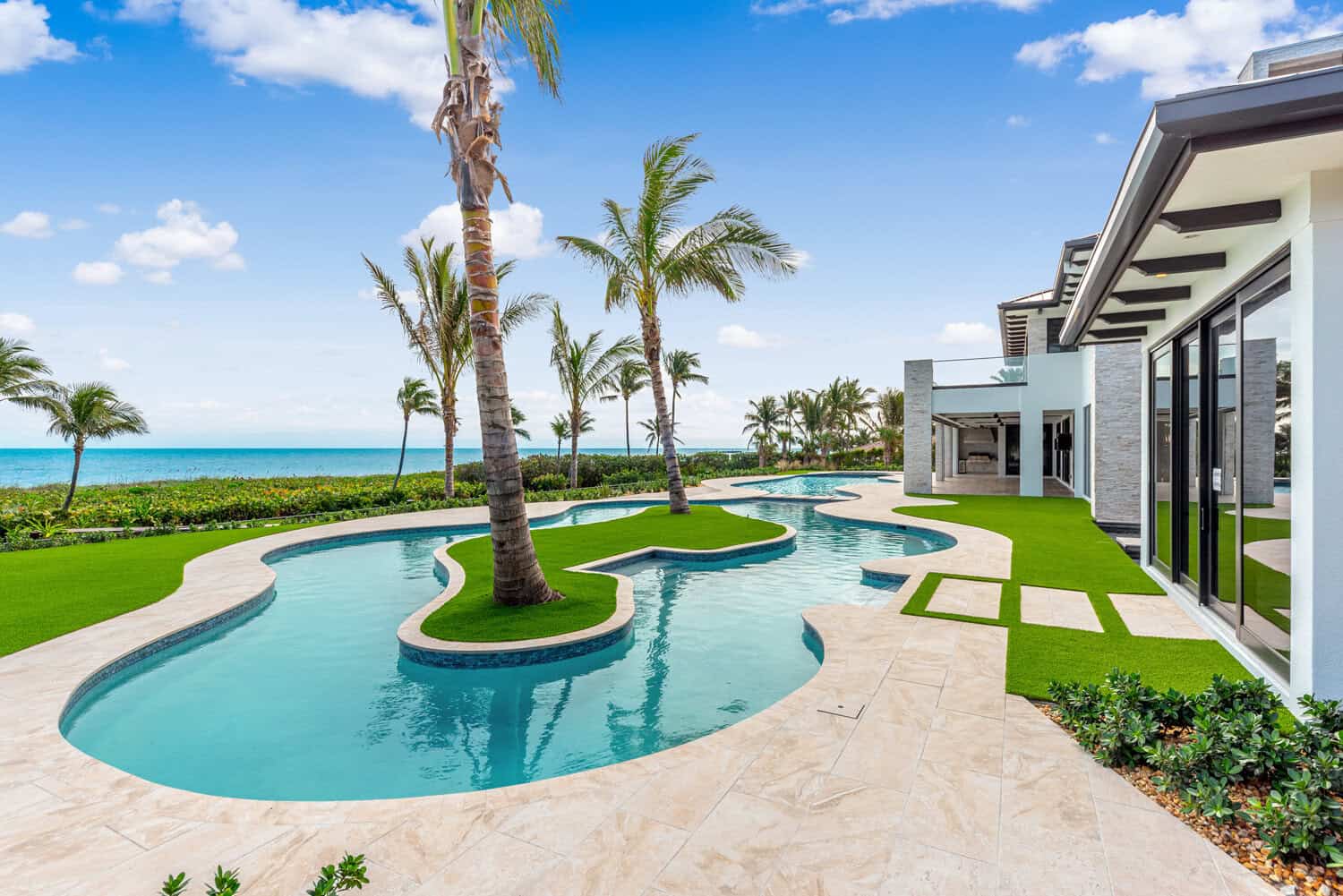
The Architecture of Arrival: Designing Luxury Entry Sequences in South Florida Estates
Why the most sophisticated waterfront homes are no longer defined by square footage alone—but by the emotional experience created before you ever step inside.
Introduction
In luxury residential construction, there is a moment that often defines the entire perception of a home long before the interiors are experienced.
It is the arrival.
The turn into a private drive. The gradual reveal of architecture through layered landscaping. The sound of water softening the transition from exterior to interior. The scale of a pivot door framed in natural stone and warm lighting. These elements create something far more powerful than curb appeal—they establish emotion, anticipation, and identity.
For high-end custom estates across Palm Beach County, Miami-Dade, Broward County, and Martin County, the arrival experience has become one of the most important aspects of residential design. Affluent homeowners are no longer focused solely on expansive interiors or dramatic exterior architecture. They want homes that feel intentional from the very first approach.
This shift has elevated the importance of entry sequences in luxury construction.
At Watlee Construction, the architecture of arrival is approached with the same level of precision as structural engineering or interior craftsmanship. Every transition—from gate entry to front door—is carefully choreographed to create a sense of calm sophistication while enhancing privacy, security, and spatial experience.
Because in modern luxury living, the most memorable homes do not reveal everything at once.
They unfold deliberately.
Market / Industry Insight
Luxury residential architecture in South Florida is becoming increasingly experiential.
While previous generations of waterfront estates often prioritized visual scale and overt grandeur, today’s homeowners are gravitating toward homes that feel more curated and emotionally engaging. The experience of moving through a property is becoming just as important as the property itself.
This is especially true in coastal communities where privacy, exclusivity, and architectural distinction carry significant value.
In neighborhoods throughout Palm Beach, Boca Raton, Fort Lauderdale, Coral Gables, and Jupiter Island, estate design is evolving toward layered presentation rather than immediate exposure. Homes are designed to create progression and anticipation instead of revealing their full scale from the street.
Several factors are driving this trend.
First, lot values across South Florida’s waterfront markets have risen dramatically. With increased density in many luxury communities, privacy has become one of the most valuable commodities in residential design. Entry sequences now function as architectural buffers that separate the public realm from the private living environment.
Second, modern luxury buyers are deeply design-aware. Many draw inspiration from boutique hospitality, contemporary resorts, and international architecture. They expect residences to deliver the same curated sense of arrival found in five-star properties.
Finally, climate-conscious architecture is influencing how exterior spaces are experienced. Covered approaches, shaded courtyards, breezeways, and landscape-integrated transitions allow homes to feel connected to the outdoors while remaining comfortable within South Florida’s tropical environment.
The result is a new design philosophy where the entry experience is no longer secondary.
It is foundational.
Design & Build Perspective
Designing a compelling arrival sequence requires much more than selecting impressive finishes or oversized entry doors. It demands coordination between architecture, landscape design, lighting, engineering, and construction execution.
The goal is to create movement, rhythm, and emotional transition.
The Private Approach
The experience begins well before the front door.
Driveways in modern luxury estates are increasingly treated as architectural elements rather than simple circulation paths. Long linear approaches, motor courts, and textured paving systems establish visual calm while guiding movement through the property.
Material selection plays a significant role here. Natural stone, porcelain pavers, exposed aggregate concrete, and refined hardscape detailing create texture without visual clutter. The objective is understated sophistication rather than excessive ornamentation.
Landscape architecture is equally important.
Layered tropical plantings, mature palms, sculptural olive trees, and integrated landscape lighting soften the architecture while controlling sightlines from neighboring properties. In waterfront estates, landscaping often frames selective views of the water rather than exposing them immediately.
This restraint creates anticipation.
The architecture reveals itself gradually, allowing the homeowner and guests to experience the property as a sequence rather than a static object.
Framing the Entry
One of the defining characteristics of luxury residential design is proportion.
The most effective entry sequences create a sense of scale without feeling overwhelming. This balance is achieved through careful architectural framing—extended rooflines, floating canopies, recessed entry courts, and layered material transitions that guide the eye naturally toward the entrance.
Large-format pivot doors have become a signature element in modern South Florida estates, but their effectiveness depends entirely on context. A beautifully crafted door loses impact if the surrounding architecture lacks compositional discipline.
Lighting is another essential layer.
Architectural lighting should never feel harsh or overly theatrical. Instead, it should create warmth and depth through subtle illumination of textures, pathways, and structural elements. Concealed linear lighting, recessed uplighting, and integrated landscape fixtures establish atmosphere while enhancing safety and usability.
In coastal environments, every exterior lighting specification must also account for humidity, salt-air exposure, and long-term durability. Marine-grade materials and weather-resistant systems are critical to preserving both performance and appearance.
Courtyard-Centered Design
One of the most significant shifts in luxury estate planning is the return of courtyard-centered layouts.
Rather than moving directly from exterior to interior, many modern homes now use transitional courtyards as intermediary spaces between arrival and living environments. These open-air spaces create moments of decompression while strengthening the home’s connection to natural light and climate.
Courtyards may include reflection pools, sculptural landscaping, fire features, or floating walkways that transform circulation into experience.
From a construction standpoint, these spaces require exceptional detailing. Drainage systems, waterproofing integration, concealed lighting, and precise material alignment all become critical. Minimalist architecture leaves little room for construction inconsistencies.
When executed properly, however, these transitions feel effortless.
The home begins to communicate through atmosphere rather than decoration.
Seamless Indoor-Outdoor Continuity
In South Florida luxury construction, the arrival experience rarely ends at the threshold.
The strongest estates maintain continuity between exterior and interior spaces through aligned sightlines, consistent material palettes, and integrated architectural language. Stone flooring extends seamlessly indoors. Ceiling treatments continue beyond glass walls. Water features visually connect multiple zones throughout the property.
This continuity creates spatial calm.
Achieving this effect requires extensive coordination between trades during construction. Floor elevations, drainage slopes, glazing systems, and finish tolerances must align precisely to preserve visual clarity.
In waterfront properties, this coordination becomes even more important because of environmental exposure. Impact-rated glazing, moisture management systems, and elevated structural assemblies must integrate invisibly into the architecture without disrupting openness or flow.
This is where craftsmanship becomes defining.
The cleaner the design, the more critical execution becomes.
Lifestyle & Client Experience
The architecture of arrival influences how homeowners feel every time they return home.
That emotional response matters more than many people realize.
A thoughtfully designed entry sequence creates separation from the pace of daily life. The transition from public street to private residence becomes calming, restorative, and intentional. Noise softens. Visual distractions disappear. The home begins to establish a different rhythm before the front door even opens.
This is particularly important for homeowners balancing demanding professional schedules and highly connected lifestyles. Luxury today is increasingly associated with emotional clarity and privacy rather than visible excess.
The arrival experience also shapes how guests interact with the home.
Layered entries create a sense of discovery that cannot be replicated through immediate visual exposure. Rather than presenting the entire property at once, the architecture reveals itself gradually through framed views, shifting light, and controlled movement.
This creates a more memorable and sophisticated experience.
At the same time, functionality remains essential.
Covered drop-off areas protect against South Florida’s intense sun and seasonal rainstorms. Integrated smart access systems enhance convenience and security without introducing visual clutter. Concealed service circulation maintains operational efficiency while preserving architectural calm.
Even garages are evolving within luxury estate design.
Rather than functioning as secondary utility spaces, garages are increasingly integrated into the overall architectural composition. Climate-controlled collector garages, custom lighting, refined flooring systems, and concealed storage transform these spaces into extensions of the home itself.
Every aspect of the property contributes to the overall experience of elevated living.
Nothing feels accidental.
Investment & Long-Term Value
In the ultra-luxury residential market, memorable architecture creates measurable value.
Homes with thoughtfully designed arrival sequences tend to stand apart immediately in both private showings and resale environments. They create emotional engagement before buyers even enter the living spaces, establishing stronger first impressions and longer-lasting perception.
This distinction is particularly important in South Florida’s competitive waterfront markets, where architectural differentiation significantly impacts long-term desirability.
Timeless entry design also ages more gracefully than trend-driven exterior features. Clean lines, natural materials, layered landscaping, and restrained detailing maintain relevance over decades rather than following temporary stylistic movements.
Construction quality further reinforces long-term value.
Exterior environments in coastal regions endure constant exposure to humidity, UV radiation, salt air, and heavy rainfall. Properly engineered drainage systems, corrosion-resistant materials, elevated structural assemblies, and high-performance finishes preserve the integrity of the home while reducing maintenance demands over time.
Landscape maturity also contributes to investment performance.
Well-designed landscapes become increasingly valuable as they mature, adding privacy, shade, and architectural softness that cannot be replicated immediately in newer construction. In many luxury properties, the landscape itself becomes one of the home’s defining assets.
Ultimately, the architecture of arrival influences more than aesthetics.
It shapes perception, experience, and long-term desirability in ways that directly affect the value of the estate itself.
Conclusion
Luxury residential construction in South Florida is evolving toward a more refined and intentional future.
The most exceptional homes are no longer defined solely by size, spectacle, or decorative excess. They are defined by experience—by how thoughtfully architecture guides movement, emotion, light, privacy, and connection to the environment.
The architecture of arrival represents this evolution at its highest level.
It transforms the simple act of coming home into something immersive and restorative. Every material, proportion, landscape element, and lighting detail works together to create a residence that feels calm, sophisticated, and deeply personal.
At Watlee Construction, we believe these moments matter. The transition from exterior to interior should feel effortless, elevated, and timeless. Achieving that level of refinement requires more than beautiful architecture—it requires precision execution, climate-conscious engineering, and exceptional craftsmanship at every stage of construction.
Because true luxury is not about immediate impact alone.
It is about creating an experience that stays with you long after you arrive.